6. Cows and Deep-Litter Barns
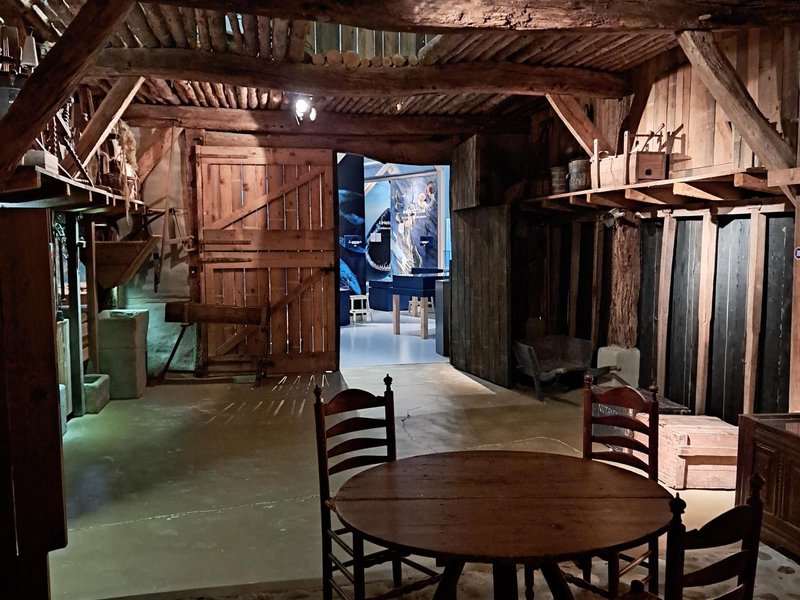
During the winter, the cows were kept in a sunken deep-litter barn.
In a deep-litter barn, the manure was not removed daily, but was slowly “accumulated.”
The farmer spread fresh layers of bedding over the manure, usually heather sods.
These are patches of heathland with roots and a layer of sand that absorbed the manure and urine.
This created a thick, damp layer that served as a bedding for the cows.
Over the course of the winter, this layer could reach a height of up to one meter.
In the spring, the barn was completely emptied, and the well-aged manure was used as natural fertilizer on the fields.
That is how the poor sandy soil became fertile, giving rise to Twente’s characteristic ash tree landscape. It did, however, take a very long time for that stretch of heathland to recover enough to allow for turf cutting to resume there.
In the following story, we'll talk about the pigs, horses, and chickens that the farmers kept.
 To start the audio click on the arrow: ▶.
 Previous listening point
 List of audiotours
 List of listening points
 Next listening point
 More information
 Scan a QR code (when applicable)