4. Vlas Chapel
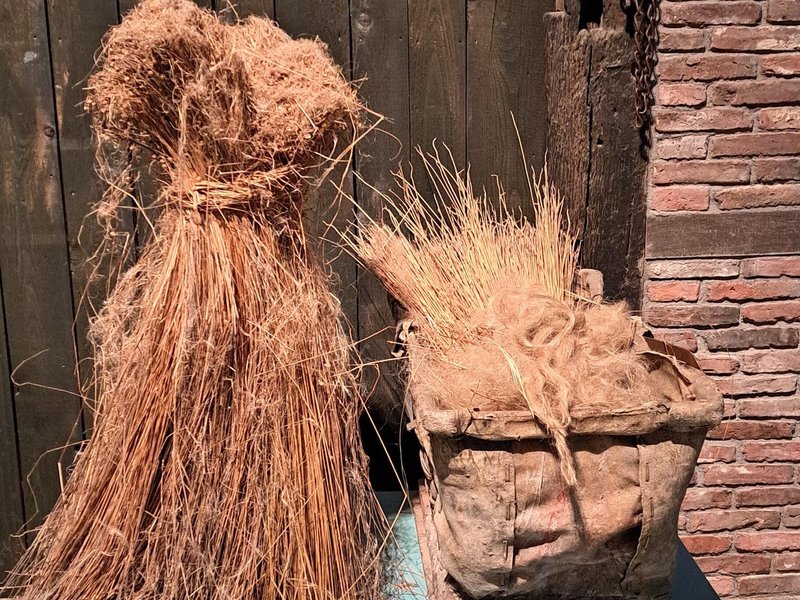
Here you can see a small flax-weaving shed.
To dry flax, it was usually set upright; this is called a "kapelletje."
Flax grows almost anywhere, so it was an easy crop to grow on the poor soil of Twente.
It was grown primarily for linen, which was used for sheets, clothing, and other fabrics.
The fibers were extracted from the stems.
In the box next to the little flax-spinning shed, you can see the fibers lying there; they feel a bit like hair.
The light brown seeds are inside the flaxseed pod.
There, they made flaxseed oil from it, which was used to protect wood from the elements.
But flaxseed and cold-pressed oil were also eaten, for example during Lent as a substitute for meat.
There are two types of flax: fiber flax, used for linen, and shorter-stalked oil flax, used for oil.
Fiber flax can also be used for oil, but yields much less than oil flax.
The number 100 plays an important role in flax.
The sowing took place around the 100th day of the year.
In June, it bloomed with small blue flowers.
One hundred days after sowing, the flax was ready to be harvested.
The entire plant was pulled out of the ground, roots and all, because the fiber extends all the way into the roots.
That's how they obtained long fibers to make textiles.
Fun fact: In the earliest versions of *Sleeping Beauty*, she didn't prick her finger on a spinning wheel, but on a straw.
Flax stalks are hard pieces of the stem.
In the next story, we'll head into Los Hoes.
In the upper right corner of the shelf, under the attic, you can see five tools that were used to turn flax into yarn.
Would you like to learn more about flax fiber? Click the "More Info" button in the Atlas van Ooit.
 To start the audio click on the arrow: ▶.
 Previous listening point
 List of audiotours
 List of listening points
 Next listening point
 More information
 Scan a QR code (when applicable)