10. The Weerdinge couple
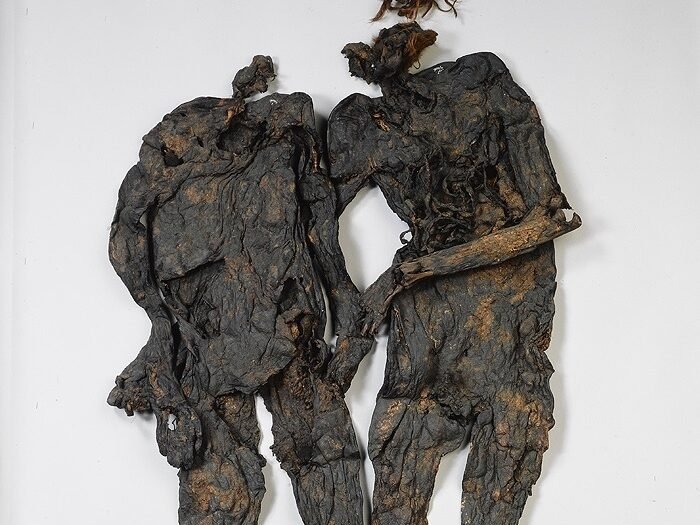
In 1904, two remarkable bog bodies were found in the Weerdingerveen in Drenthe. A peat worker discovered them while cutting peat. The bodies were so well-preserved that they were taken to a morgue in Nieuw-Weerdinge. Thanks to the peat, the skin and hair were still partially intact. This discovery is known as “The Weerdinge Couple.”
Research shows that the remains belong to two men who likely lived during the late Iron Age, around the beginning of the Common Era. DNA analysis conducted in 1990 revealed that they had different mothers.
It is notable that no clothing or personal belongings were found. The men had been laid naked in the peat. One of them may have had a stab wound to the chest, which could indicate a violent death.
Scientists believe this was no ordinary burial. In ancient cultures, swamps were sometimes used for rituals or as a form of punishment. People might have been left there to appease the gods or to enforce social norms.
The Roman writer Tacitus also described how the Germanic tribes sometimes left people in swamps as punishment.
We don't know for sure, but this discovery shows that peatlands held a special—and sometimes harsh—significance in the lives and minds of people in ancient times.
The next listening point is the wooden pulley in Steenwijk.
 To start the audio click on the arrow: ▶.
 Previous listening point
 List of audiotours
 List of listening points
 Next listening point
 More information
 Scan a QR code (when applicable)