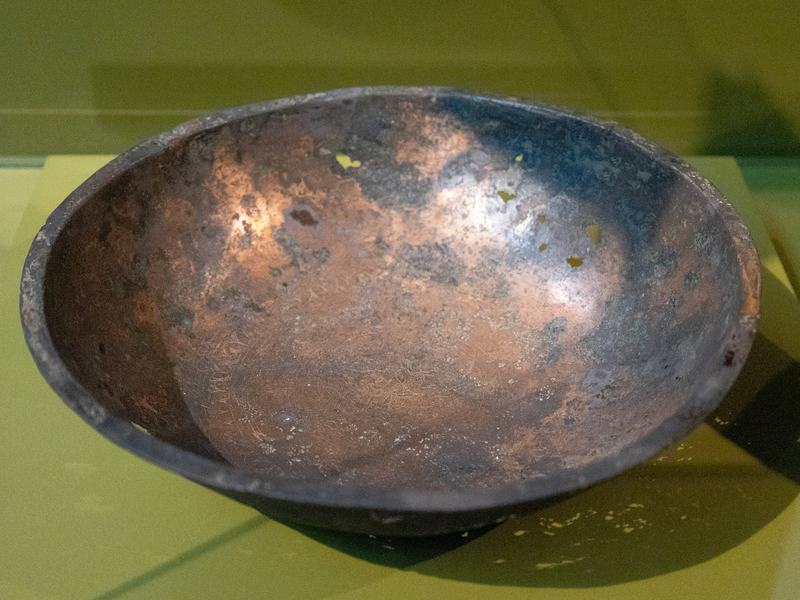
14. Copper Hanseatic dish with an engraving of Humilitas (ca. 1200 AD)
Long before the advent of Christianity, people in Twente made offerings to the forces of nature and the gods. They often did so in wet areas, such as rivers and marshes. Water was a special place where people would make offerings in exchange for protection or a bountiful harvest.
Later, people became Christians. But old customs didn’t disappear right away. We can see that in this Hanseatic dish. The dish bears the inscription “Humilitas,” Latin for humility. It illustrates how people were expected to behave according to the church.
A dish like this was used for washing hands, for example before a meal. It was not only practical, but also had symbolic significance: purity of both body and behavior.
Yet we also see traces of the past. Some of these precious plates have been found in rivers, such as the IJssel. They were deliberately left there, just like offerings from the pre-Christian era. The meaning had changed. Now it was an expression of gratitude to God or a saint. The act remained the same.
Old customs continued in this way. Even ancient stones from pagan times found a new home in churches, for example as thresholds or in the walls. This helped people adjust to the new faith. We don’t know exactly what their original purpose was. Perhaps they were associated with a sacred site or sacrificial rituals.
The next and final stop marks the end of this audio tour.
 To start the audio click on the arrow: ▶.
 Previous listening point
 List of audiotours
 List of listening points
 Next listening point
 More information
 Scan a QR code (when applicable)